
Event Recap: Tech in Asia Conference 2025, Jakarta, What Builders, Founders, and Investors Are Really Talking About
SEA Indonesia AI Startups Founder 3 Minutes
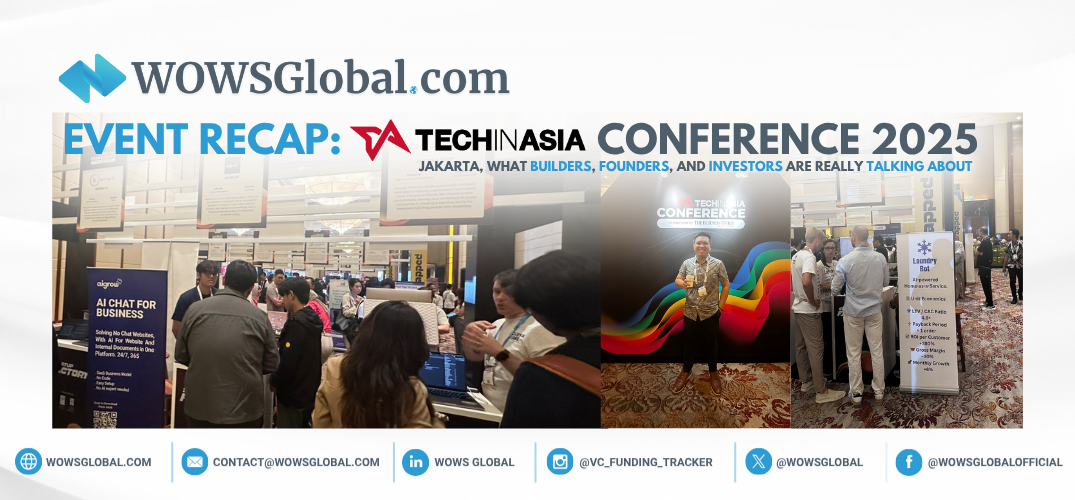
Quick take: Tech in Asia Conference returned to Jakarta on 22–23 October 2025 at The Ritz-Carlton Pacific Place, drawing the region’s startup operators, investors, and ecosystem leaders for two days of candid conversations about growth, capital, and pragmatic AI. Kingsen Yan, Head of Investments, attended on behalf of WOWS Global.
Why this conference mattered
This year’s theme, essentially a call to “defy expectations” and #justkeepbuilding, framed a mood shift from survival to disciplined scaling. Across main-stage talks and the show floor, the focus sharpened on operational AI, capital efficiency, and Indonesia as a springboard to Southeast Asia. Official program pillars like Connection Hub, Startup Factory, and Startup Arena kept the hallways busy with targeted matchmaking and pitch energy.
Attendance was strong, with regional media highlighting AI’s central role in the agenda and an audience numbering in the thousands, a signal that founders and funds alike see momentum returning to SEA tech.
Three headlines for founders and investors
1. AI is now an operations story, not just a demo.
Sessions and hallway chatter shifted from “model talk” to unit economics, where AI can cut COGS, collapse cycle times, and sharpen funnels today. The winning posture: deploy small, targeted AI workflows (sales ops, fraud detection, demand forecasting) with clear KPI baselines, then compound.
2. Capital is selective, but it’s there for the crisp and compounding.
Investors emphasized repeatability (cohort retention, payback under 12 months, gross margin expansion) and non-obvious distribution as the quickest reads on resilience. The most credible decks linked every growth claim to verifiable data exhaust, usage, ops telemetry, or customer-level economics. Conference programs like Connection Hub and Startup Arena reinforced that discipline by putting traction in front of capital.
3. Indonesia is the proving ground, regional by design.
Speakers and side events underscored Jakarta’s role as the SEA proving market: win here with local nuance (payments, logistics, pricing power), then roll out to the Philippines, Vietnam, and beyond. The venue and dates anchored a week of satellite meetings across SCBD, a reminder that Jakarta is back to full-strength dealmaking.
What we heard in the rooms (and hallways)
-
AI budgets are shifting from “innovation” to “OPEX wins.” Teams that can show a defensible cost take-out or throughput gain (measured weekly) are outperforming those pitching abstract platform roadmaps.
-
Sales-led growth is being re-tooled. Playbooks now favor smaller, sharper pods with RevOps automation over headcount expansion, a thread echoed across founder roundtables.
-
Infrastructure and compliance still decide B2B velocity. In Indonesia, payment rails, tax compliance, and data residency surfaced as the “last mile” for enterprise adoption, best handled with local partners and workflow-native integrations.
If you’re a founder, here’s your 30-day action plan
-
Instrument your AI wins. Pick two operational use cases (e.g., LTV-weighted churn prevention, invoice matching). Set pre-/post- baselines and publish weekly deltas to your board. That turns “AI narrative” into hard ROI.
-
Localize to accelerate enterprise sales. Map Indonesia-specific blockers (procurement, data flows, VAT). Pilot with one anchor customer and one channel partner to compress sales cycles.
-
Reframe your deck around efficiency. Lead with retention, payback, and margin expansion before topline. Investors at TIA rewarded compounding efficiency over vanity growth.

If you’re an investor, here’s what to watch
-
“AI inside” in non-obvious verticals. Logistics nodes, agri-supply, and mid-market ERP extensions showed promising traction where workflow data is rich and messy.
-
Indonesia-first GTM with regional adjacency. Preference for teams that validate PMF in Jakarta while pre-wiring the Philippines/Vietnam pipeline. Venue and timing reinforced Indonesia’s center-of-gravity status this season.
-
Program-validated founders. Startup Arena and Connection Hub surfaced operators already pressure-tested through customer intros and mentor reviews.
WOWS at Tech in Asia
Kingsen Yan, Head of Investments, attended for WOWS Global, connecting with founders and co-investors across the floor. Our goal in Jakarta: sharpen founder readiness for institutional conversations and match them with stage-appropriate capital, especially where AI delivers measurable operating leverage.
We’re always up for a conversation, schedule a quick call with us to go deeper.
FAQS
-
What were the top takeaways from Tech in Asia 2025?
AI has shifted from flashy demos to practical operations, think cost reduction, faster cycles, and measurable KPIs. Capital is selective but available for efficient, data-driven companies. Indonesia remains a powerful proving ground: win locally with payments, logistics, and compliance, then expand regionally to the Philippines, Vietnam, and beyond. -
Which metrics matter most to investors right now?
Focus on retention and healthy cohorts, payback periods under 12 months, and steady gross margin expansion. Show real, verifiable traction, usage, revenue, and operational improvements tied to AI or workflow automation. Clear unit economics and repeatable growth tell the best story and make fundraising conversations faster and more productive. -
How to partner with WOWS Global
The easiest way to start is to book a short intro call via our calendar: Schedule here. If you already have materials ready, you can also share your deck for review: Submit your pitch deck. We’ll respond with next steps and the best-fit investor pathway.
Related Posts
-

Retail Investors AI Startups Southeast Asia 4 Minutes
Polarlyst: The Thai AI “Co-Pilot” Bringing Institutional-Style Research to Retail Investors
Polarlyst is a Thai AI-driven investing “co-pilot” turning complex financial data into clear, actionable insights for retail investors. In this WOWS Global spotlight, we break down why they stand out, why they’re worth watching, and what their rise says about the next wave of WealthTech in Southeast Asia. -
Fintech SEA AI Startups Early Stage 5 Minutes
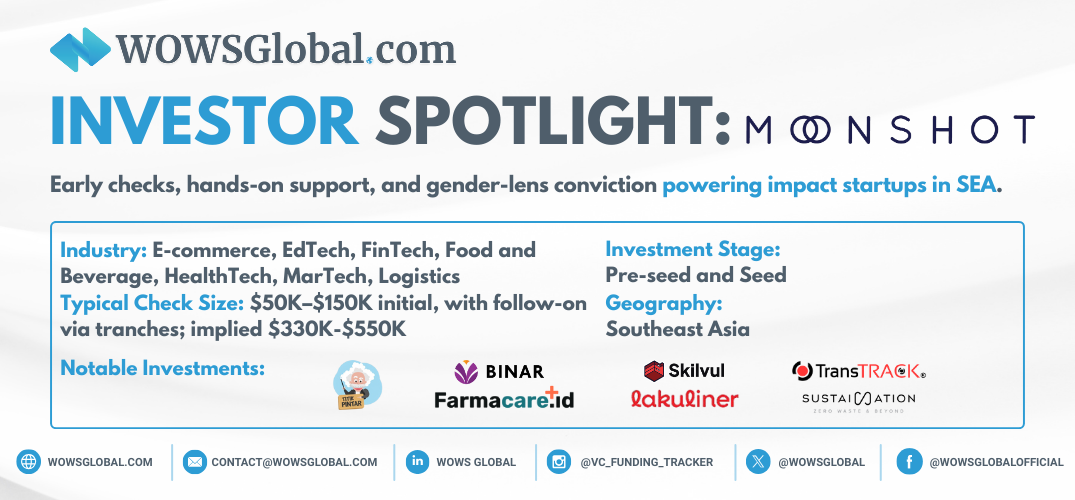
Moonshot Ventures: Betting Early on Southeast Asia’s Purpose-Driven Builders Starting with Women-Led Innovation in Indonesia
Moonshot Ventures invests early in Southeast Asia’s most mission-driven founders, pairing capital with deep operating support. Through IWEF, it’s helping women-led innovation in Indonesia scale with a tranche-based model and a strong partner network. -

Capital SEA B2B ASEAN 7 Minutes
Cocoon Capital: Backing Southeast Asia’s Quiet B2B Revolution
From AI-powered stroke diagnostics to pharma distribution and SME payment rails, Cocoon Capital backs the “invisible” infrastructure powering Southeast Asia’s next wave of growth. This Investor Spotlight unpacks their B2B and deep-tech thesis, how they invest, and the founders they champion. -

Tourism Travel SEA Tech 5 Minutes
Yacht Me Thailand: Digital Yacht Charter Platform for a Fragmented Market
Yacht Me Thailand is digitising yacht and boat charters across Thailand’s top marine destinations. With operator-first tools, sustainability at its core and ambitions to become a regional boating OTA, the platform is emerging as a notable travel-tech and marine tourism play. -

Investor Due Diligence Readiness Virtual Data Room Founder 4 Minutes
Data Room Done Right: A Founder’s 30-Item Investor Readiness Checklist
Investors don’t fund mysteries. This Seed–Series A checklist shows exactly what to include, governance, product, metrics, financials, security, and round mechanics, so diligence speeds up, not stalls. Need help? WOWS Global can review and structure your data room. -
Fintech AI Startups Early Startups SEA 4 Minutes
The Dip in SEA Fintech Funding: What Startups Can Learn
SEA fintech funding has dipped, but capital is still on the field for disciplined teams. This article unpacks what the new funding rules look like and how founders can upgrade models, governance, monetization, and capital stacks. Learn where investor expectations have shifted and how WOWS Global can help you get raise ready.