
Public in Scale, Private by Choice
Private Market Late Stage AI Liquidity 8 Minutes

A few years ago, scale usually meant going public. Today a cohort of global platforms operate with public company heft at tens or hundreds of billions in value, millions of customers, and real revenue, yet stay private by design. The reason is simple. Private markets now deliver what late stage companies care about most: ample capital and real liquidity, without the cadence and disclosure demands of quarterly earnings. Secondary transactions, continuation vehicles, and mega growth rounds have matured into a parallel exit lane, letting founders extend the private window while still taking care of employees and early investors.
What is different in 2026 is that the window is being converted. Several of the companies that used private capital to reach public company scale are now choosing to list, and they are doing it on their own schedule rather than because they ran out of options. The through line is control. These businesses can act like public market leaders while deciding their own timing to file.
What changed in private markets
- Liquidity without IPOs. Secondary programs let employees and early investors sell a portion of holdings on a predictable cadence. GP led processes and structured tenders now happen regularly. Companies can offer targeted liquidity, keep the cap table aligned, and stay focused on long term execution. Stripe and Revolut have both turned the annual or periodic secondary into a repeatable event.
- Deep, patient late stage capital. Sovereign funds, growth equity, and crossover investors routinely underwrite multi year roadmaps. AI, fintech, data infrastructure, and defense attract the largest checks. With that depth of capital available privately, management teams can fund products, go to market, and M&A without touching the public markets until they choose to.
- A cultural reset on timing. Boards and founders increasingly treat an IPO as one financing option among several, not a finish line. Teams build public company discipline early, then sequence a listing to when it strengthens the strategy, the governance narrative, and the investor mix. In 2026 a wave of these companies has judged the moment right.
The poster children, in brief
Stripe. In February 2026 Stripe completed an employee tender offer that valued the company at about 159 billion dollars, up roughly 74 percent from the 91.5 billion figure it used a year earlier. The company disclosed 1.9 trillion dollars of 2025 payment volume, up 34 percent, and described itself as robustly profitable.
Revolut. In November 2025 Revolut ran a secondary sale that implied a valuation near 75 billion dollars, with participation from crossover investors including Coatue, Greenoaks, Andreessen Horowitz, and Nvidia's NVentures. It has since secured a full UK banking license in March 2026 and applied for a US bank charter. By June 2026 the company was weighing a fresh secondary at around 115 billion dollars, and it has told investors an eventual IPO could target 150 to 200 billion dollars, though it has signalled it will not list before 2028. Revolut is the clearest example of secondaries used as a deliberate staging mechanism.
Databricks. The company closed a Series L at about 134 billion dollars in December 2025, then completed more than 7 billion dollars of combined equity and debt at that valuation in February 2026, alongside a revenue run rate past 5.4 billion dollars growing more than 65 percent year over year. By June 2026 reporting pointed to talks to raise fresh capital at roughly 165 to 175 billion dollars. Management now describes the company as IPO ready, with a listing widely expected as soon as late 2026 or in early 2027.
Anthropic. In May 2026 Anthropic raised a 65 billion dollar Series H at a 965 billion dollar post-money valuation, with its run rate revenue crossing 47 billion dollars. On June 1 2026 the company confidentially submitted a draft S-1 to the SEC. Anthropic is a live illustration of the pattern in this piece. It scaled to near a trillion dollars in private valuation, then moved toward a listing on its own timeline rather than under pressure.
Shein. After a London listing stalled on regulatory approvals, Shein refocused on a Hong Kong offering and filed confidentially with the exchange. Reporting through 2026 points to a targeted valuation of roughly 30 to 50 billion dollars, a marked step down from about 66 billion in a 2023 round, reflecting a profit decline and a tougher regulatory and trade backdrop. Shein shows how multi jurisdictional paths can be used to manage review and market conditions before a final venue is set.
The common thread is straightforward. These companies can access capital and provide liquidity privately, maintain strategic flexibility, and keep sensitive metrics out of constant public scrutiny for as long as it suits them. When they do list, it is because the timing serves the mission, not because they must.
Why stay private, and why list now
Strategic freedom over quarterly cadence. Frontier categories such as AI, fintech, and defense require lumpy capex and fast iteration. Private status reduces the risk of managing the narrative rather than the roadmap.
Cleaner cap tables and retention. Predictable tenders and company led programs reduce pressure to list just to unlock liquidity, while preserving control structures that support long horizon bets.
Financing on your terms. Late stage private rounds and private credit structures can match or beat public follow ons in speed and flexibility, especially when the story is still evolving.
Market windows are cyclical. Even great companies prefer to list into receptive markets with the right peer set and analyst coverage. The 2026 window has drawn AI and software leaders off the sidelines, and waiting for it was itself an advantage.
What this means for Southeast Asia
Southeast Asia sits at the crossroads of this shift. The region has deep pools of capital, especially in Singapore, an increasingly sophisticated private credit ecosystem, and founders building public scale platforms. The playbook above is already influencing strategy, and the region now has its own live test cases.
Carro, Southeast Asia's largest online used car marketplace, is preparing a US IPO as early as 2026, aiming to raise up to 500 million dollars at a valuation above 3 billion dollars. If it lands it would be the largest US listing by a Southeast Asian company since Sea in 2017, and a signal for the wider ecosystem.
Traveloka is weighing a public listing, with reporting pointing to a 5 to 6 billion dollar valuation and a possible dual listing at home and abroad. It is backed by GIC, the Qatar Investment Authority and Expedia, and has spent recent years improving unit economics, which gives it more control over timing. The company itself has not confirmed a valuation or a date.
Carsome and Xendit remain widely viewed as regional public market candidates. Each has access to institutional capital, partnerships, and private debt, and each can scale as a private market champion, build public company muscle, and list when venue, valuation, and story align.
For founders across Indonesia, Vietnam, the Philippines, Thailand, and Malaysia, the practical takeaway is to design a liquidity roadmap, not just a funding plan. Treat employee liquidity as a product, schedule tenders responsibly, and build audit ready reporting early. For investors, the implication is clear. Private valuation discovery is normal, and exposure may come through late stage rounds, structured secondaries, or continuation vehicles ahead of an eventual IPO.
Founder and investor playbook
Plan liquidity, not just cash. Set policies for tender eligibility, frequency, and size. Keep the cap table clean and performance aligned.
Anchor with the right capital. Choose partners who understand local regulation and cross border expansion, and who can support multi year buildouts in data, AI, and financial infrastructure.
Stay file ready. Maintain public grade metrics, governance, and controls. When the window opens, you want a choice of venue, not a scramble. The companies listing in 2026 spent years preparing for exactly this moment.
Use private credit and alternatives thoughtfully. The menu now includes revenue based lines, warehouse facilities, and structured solutions that reduce dilution while funding scale.
Map venues early. Weigh the regulatory and investor depth trade offs across Singapore, the United States, Hong Kong, and other markets. Prepare documentation and audit trails ahead of time.
WOWS' Take
Liquidity and legitimacy no longer require an IPO, and the 2026 listing wave proves the point in reverse. Category leaders spent years compounding privately, then chose their moment to file. In Southeast Asia, WOWS Global helps you plan tenders, structure late stage rounds, and build public grade discipline before you file. Speak with our experts to map your private first path.
FAQs
Do private secondaries hurt future IPOs?
Not if they are structured well. Tenders that are modest in size, regular in cadence, and tied to performance can improve retention and reduce pressure to list prematurely. Stripe and Revolut have run repeated secondaries and remain among the most sought after listings on the horizon. The key is clean documentation, fair pricing, and avoiding complex preferences that confuse future investors.
What signals tell me it is time to go public?
You want durable revenue with improving cohort health, repeatable growth engines, and governance that stands up to public scrutiny. Also watch for strategic needs, such as acquisition currency, broader brand trust, or regulatory benefits that accompany a listing in your target markets. The 2026 cohort moved once profitability and market receptivity lined up together.
How should SEA founders think about venue selection?
Start with where your investors and customers are, and where coverage and peer sets exist. Weigh auditing standards, ongoing disclosure, costs, and liquidity depth. Carro is testing US appetite, Shein pivoted from London to Hong Kong, and Traveloka is considering a dual listing. Prepare for multiple venues in parallel, then decide based on market receptivity and the narrative that best supports long term compounding.
Related Posts
-

AI Digital Marketing Technology AI Startups 3 Minutes
Elarislabs AI Company Profile: AI Creative Infrastructure for Marketing Teams
From ideation to publishing, Elarislabs AI is reimagining how modern marketing teams create and launch content. With a workflow-first approach spanning AI video, product staging, localization and multi-channel deployment, the startup is emerging as a compelling player in the next wave of creative infrastructure. -

AI Monetization Logistics Experiences 4 Minutes
Spark Love Company Profile: AI-Powered Experiential Dating That Gets People Offline
Spark Love is rebuilding dating around what actually matters: meeting in real life. By combining AI-driven compatibility with bookable premium experiences and safety-forward flows, Spark turns matches into memorable dates and gives modern singles a clearer path from chat to connection. -

AI Enterprise Scalable Solutions Startup governance 5 Minutes
Feedloop and the Enterprise AI Race in Indonesia: Built for Compliance, Built for Scale
In a crowded GenAI market Feedloop is betting on what enterprises actually buy: control, compliance and deployable automation. Here is what makes the company stand out and why investors are watching. -

AI Finance Startup Finance CFO 3 minutes
Smart Finance, Winning Moves: How Fractional CFOs Use Tech and AI to Raise the Score
A quick, plain-English playbook on how fractional CFOs apply AI to sharpen forecasts, streamline reporting, and guide smarter decisions, so teams move faster and investors get clarity. Talk to WOWS Global to put it in motion. -

SEA & Middle East Investment AI Highlight 6 Minutes
WOWS’ 2026 Predictions: 10 Bets on Where Southeast Asia’s Money Will Move Next
WOWS’ 2026 Predictions are a forward-looking map of where Southeast Asia’s money could move next: operator-led capital, Thailand’s mid-stage moment, SME credit as a major return engine, an AI survival test, and a wave of M&A. Investors, founders, and SMEs can use these 10 bets to plan for what may come. -
Biotech AI SEA Startup & Venture Capital deep-tech 6 Minutes
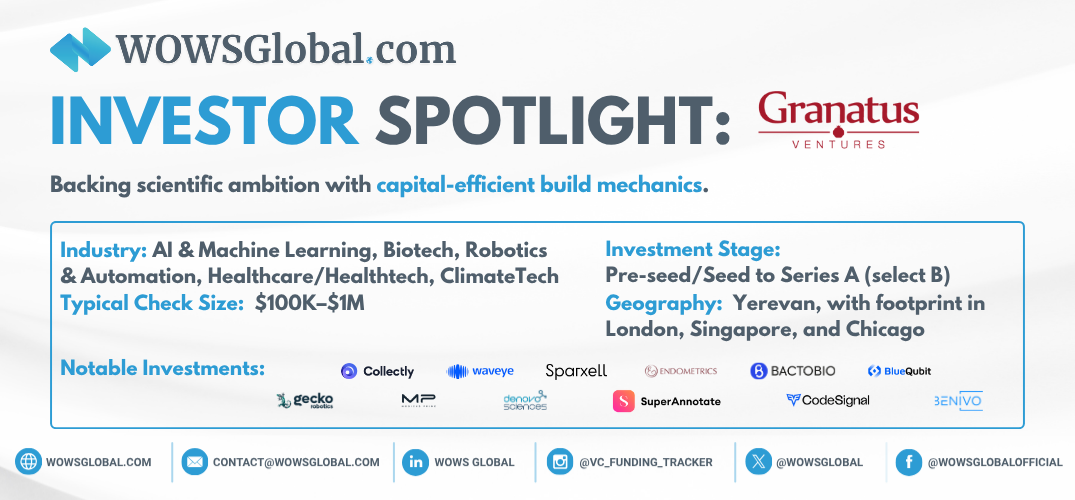
Granatus Ventures: Deep-Tech Builders Bridging Armenia and Southeast Asia
Granatus Ventures backs IP-rich startups in AI, biotech, robotics, and advanced/quantum computing, pairing early checks with an Armenia engineering engine and a Singapore touchpoint for SEA pilots. Learn how their SDG-aligned thesis translates into practical capital and deep technical diligence.