
WOWS Global's Gagan Ajmani joined Bangkok Startup Association's Capital in Chaos event to unpack fundraising discipline, investor readiness and traction today.
Emerging Markets SEA Bangkok Events Investment 3 Minutes
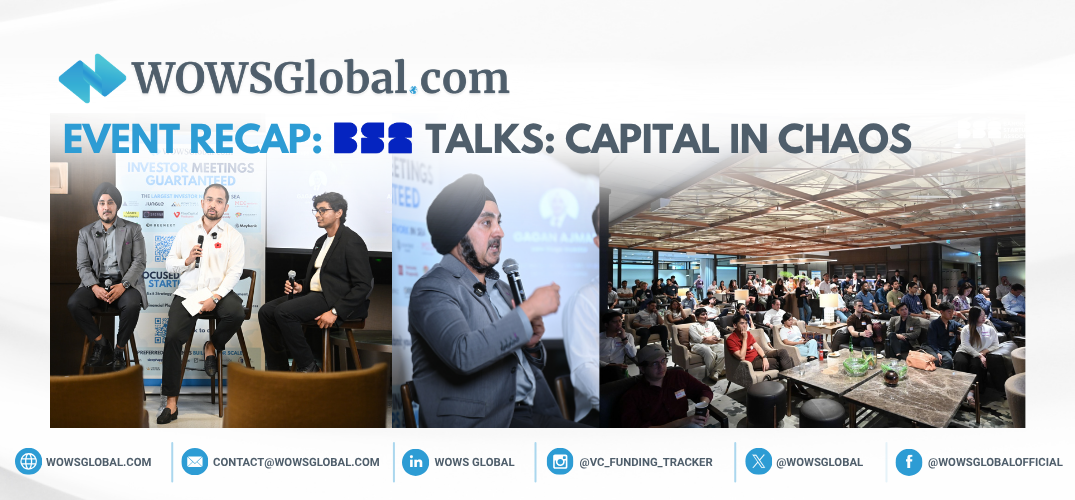
Capital in Chaos: How Founders & Investors Navigate Uncertain Markets brought Bangkok’s startup community together for a timely discussion on what it takes to raise capital when markets are uncertain. Held on 7 May 2026 at The Great Room, Gaysorn Tower in Bangkok, the event gathered founders, investors, operators, and ecosystem builders to unpack how investor expectations are changing across different stages of company growth.
The session was organized in collaboration with Bangkok Startup Association, with Gagan Ajmani, CEO of WOWS Global and former CFO of Deliveree, joining as a speaker alongside Abhi Agarwal, CEO of Living Roots. The conversation was moderated by Alex Avanth, an advisor, investor, coach, and General Partner at MoreFutures South East Asia.
Fundraising has changed, but capital has not disappeared
The event’s core premise was simple: the old fundraising playbook no longer works the same way.
Founders are now building in a market shaped by geopolitical tension, rising interest rates, tighter capital markets, and more selective investors. Some investors are pulling back, while others continue to deploy capital but with higher expectations around proof, discipline, and resilience.
Gagan’s lens: the two Ts investors look for
Drawing from his experience as CEO of WOWS Global and former CFO of Deliveree, Gagan emphasized that founders need to understand how investors evaluate risk before entering fundraising conversations.
One useful lens is what he described as the importance of the two Ts: traction or track record.
For companies with measurable traction, investors want to see evidence that the business is working. That can include customer growth, revenue, retention, margins, repeat usage, or other proof points that show the company is moving beyond assumptions.
For earlier-stage companies where data is still limited, the founder’s track record becomes even more important. Investors look at whether the team has the experience, insight, credibility, and execution ability to navigate uncertainty before the numbers are fully proven.
This matters because not every company will be assessed in the same way. A first-time founder raising at MVP stage will face different questions from a later-stage company preparing for Series A and beyond. What stays consistent is the need to reduce perceived risk.
Is your company suited for VC-scale growth?
Another key point from Gagan’s perspective was that founders should be honest about whether their company is built for the scale expected by venture capital.
VC funding can be powerful, but it also comes with expectations: large markets, rapid growth, meaningful upside, and the ability to return a fund-level outcome. Not every strong business fits that model, and that is not a failure.
For some founders, alternative sources of funding may be more suitable. Depending on the business model, stage, and capital needs, this could include revenue-based financing, debt, strategic partnerships, grants, customer-funded growth, or other non-dilutive and less-dilutive options.
The key is alignment. Founders should not raise VC simply because it is the most visible path. They should understand what kind of capital best fits the company they are building.
What founders should prepare before raising
The discussion also reinforced the practical work founders need to do before speaking with investors.
A strong pitch is only one part of the process. Founders need clean numbers, clear assumptions, a realistic use of funds, and a sharp understanding of what milestones the next round of capital is meant to unlock.
They also need to be ready for diligence. Investor interest can fade quickly when financials are unclear, cap tables are messy, projections feel unrealistic, or the founder cannot explain the business model with confidence.
In uncertain markets, preparation becomes a competitive edge. The companies that stand out are the ones that can give investors clarity quickly.
WOWS Take: Our role in founder readiness
For WOWS Global, the conversation connects directly to its work with founders across Southeast Asia.
As capital becomes more selective, founders need more than access to investors. They need the right materials, financial clarity, fundraising strategy, and understanding of how investors evaluate opportunities at each stage.
WOWS Global supports founders in strengthening that readiness, from refining pitch materials and financial models to helping teams better understand what investors need to believe before committing capital.
Capital in Chaos is not that fundraising has become impossible. It is that fundraising has become more disciplined.
Founders who understand their numbers, know their capital options, and can clearly show either traction or track record will be better positioned to navigate a selective market.
For WOWS Global, that is where the opportunity lies: helping founders build the clarity, structure, and confidence needed to raise the right kind of capital for the company they are actually building.
Related Posts
-

Investment Southeast Asia Fintech AI 5 Minutes
September Investment Highlights: Fintech Consolidation, AI Infrastructure and Southeast Asia's Exit Window
Billion-dollar fintech M&A, a record IPO and an AI infrastructure reset: here's what moved Southeast Asia investments in September 2026, and what it means for your next raise. -
AI Investment Southeast Asia Capital 4 Minutes
Investment Highlights August 2026: Southeast Asia's Big-Check Era Takes Hold
The money is back in Southeast Asia, and it's arriving in bigger checks than ever. Capital jumped 137% to $12.8B this year while deal count fell 30%. Inside: Acrab's $130M AI raise, three blockbuster IPOs, and what the flight-to-quality market means for your next round. -

Investment Highlight Southeast Asia SEA 7 Minutes
Investment Highlights July 2026: Southeast Asia's Exit Window Swings Wide Open
July 2026 saw Southeast Asia's exit window swing wide open: GCash's record IPO run, MoMo's buyout interest, and fresh capital flowing into robotics, insurtech and AI. -
Investment Highlight SEA AI 6 Minutes
Investment Highlights June 2026: Southeast Asia Builds the AI Backbone While the Exit Window Cracks Open
Southeast Asia's June 2026 was deliberate, not euphoric. Capital concentrated around the AI infrastructure buildout, deep tech and health tech kept punching above their weight and, for the first time in three years, the exit window cracked open with GCash parent Mynt filing for a record US$1.5 billion IPO. We break down the deals that mattered, who's writing the cheques and what it all means for founders and investors. -
SEA Investment MENA Private Credit Fintech 7 Minutes
Investment Highlights May 2026: SEA Puts Data Centres on the Balance Sheet While MENA Turns Credit Into Infrastructure
May’s investment activity across SEA and MENA shows capital is still moving, but with sharper discipline. From data centres and green infrastructure in Southeast Asia to private credit and fintech rails in MENA, investors are backing companies with stronger fundamentals and clearer capital stacks. -
SEA MENA Highlight Investment Funding 5 Minutes
Investment Highlights April 2026: SEA Builds The Rails And MENA Turns Credit Into Product
April’s startup funding story was not about fireworks. It was about rails. Across SEA and MENA, investors backed infrastructure, credit, climate, AI and regulated platforms with clearer paths to scale.