
Investment Highlights May 2026: SEA Puts Data Centres on the Balance Sheet While MENA Turns Credit Into Infrastructure
SEA Investment MENA Private Credit Fintech 7 Minutes
May was not a “risk-on is back” month. It was a paperwork month.
In Southeast Asia, the money moved toward assets investors can underwrite: data centres, battery supply chains, SME credit, green infrastructure and regulated wealth platforms. DealStreetAsia’s latest regional backdrop makes the mood clear: Q1 2026 delivered the lowest quarterly deal count in at least eight years, even though headline funding was inflated by Singapore-based DayOne’s $2 billion Series C. Investors are still writing cheques, but they want collateral, contracted demand, licences and distribution before they lean in.
In MENA, the debt machine did not slow down. It became more sophisticated. May’s tape was full of securitisation, private credit, Murabaha facilities, fintech operating systems and sovereign paper. The region is not just funding startups. It is building the financial plumbing around them.
Southeast Asia: The heavy rails get financed
The month’s loudest message from SEA was simple: compute is now infrastructure, not a pitch-deck buzzword.
Indonesia stood at the centre of that shift. DCI Indonesia secured a 17 trillion rupiah, or roughly $976 million, credit facility from BCA to fund data-centre construction, capacity completion and contracted customer demand. Princeton Digital Group followed with about $856 million in financing for its Indonesia hyperscale expansion, including a $456 million syndicated green loan and a roughly $400 million accordion facility tied to its JC3 campus in Bekasi.
That is not venture capital behaving badly. That is infrastructure finance behaving exactly as it should.
May deal scoreboard: Southeast Asia
DCI Indonesia secured nearly $1 billion in bank financing. The Indonesian data-centre operator landed a 17 trillion rupiah facility from BCA, with proceeds earmarked for capex, construction completion and customer-contracted capacity. The collateral package included land, buildings, equipment, cash collateral and insurance receivables.
Princeton Digital Group raised about $856 million for Indonesian hyperscale data centres. The financing included a $456 million syndicated loan from DBS, HSBC, Maybank, SMBC and Standard Chartered, plus an accordion feature of about $400 million. The funds support PDG’s JC3 campus in Bekasi, expected to deliver 120MW of IT load.
Pentagreen Capital hit an $800 million second close. The HSBC- and Temasek-backed sustainable infrastructure debt platform expanded its Green Investments Partnership, a blended-finance vehicle under Singapore’s FAST-P programme.
Konvy raised $22 million for beauty commerce expansion. The Thai omnichannel beauty and personal-care platform closed a Series B led by Cool Japan Fund, with existing investors including Insignia Ventures Partners. The company is pushing deeper into Southeast Asia, including the Philippines and Malaysia, while expanding private labels.
Pluang raised $10 million and moved into local equities. The Indonesian investment platform added fresh capital while launching domestic stock trading, broadening beyond US stocks, ETFs, crypto, gold, mutual funds and derivatives.
TDK moved for Malaysia’s Linergy Power. The Japanese electronics group agreed to acquire the lithium-ion battery maker for about $241 million through its Singapore-based rechargeable-battery unit, Amperex Technology.
First Circle added fresh bank funding for SME lending. The Philippine fintech secured a 300 million peso sustainable finance credit facility from Taiwan’s Cathay United Bank to support lending to small businesses.
What this tells investors: SEA
The Southeast Asia story is no longer just “digital adoption.” It is power, land, cooling, bankability and regulated rails.
The biggest tickets went to infrastructure-like assets, especially data centres, where demand can be tied to capacity contracts and financed through large bank syndicates. That matters. SEA’s AI and cloud story will not be built on seed rounds alone. It will need project finance, green debt, private credit, utility planning and institutional balance sheets.
The second signal is that fintech is still alive, but the bar has moved. Pluang is expanding into licensed local capital-market products. First Circle is funding SME credit with a bank facility. The common thread is not “growth at all costs.” It is financial services with a clearer funding model.
Consumer is not dead either. Konvy shows that category depth, brand relationships and regional distribution can still attract equity. But the easy-commerce era is over. Investors want platforms with control over margin, data and customer repeat behaviour.
The SEA May tape was not broad. It was selective. But selective is not the same as frozen.
MENA: Credit gets engineered while fintech rails get global validation
MENA’s May headline was not simply that companies raised money. It was how they raised it.
TruKKer secured a trade-receivables securitisation. GymNation tapped private credit. Arib blended equity with Sharia-compliant Murabaha facilities. Saudi Arabia kept issuing domestic sukuk. The UAE continued building its dirham-denominated government securities curve. In parallel, fintech infrastructure pulled in global names, most notably Andreessen Horowitz’s first GCC investment through Stitch.
This is what a maturing funding market looks like: equity for software, debt for cash flows, securitisation for receivables and sovereign paper for the benchmark curve.
May deal scoreboard: MENA
Saudi Arabia closed a 2.418 billion riyal May sukuk issuance. The National Debt Management Center said the issuance was split across five tranches under the Kingdom’s riyal-denominated sukuk programme.
The UAE completed 1.1 billion dirhams of May Treasury-bond auctions. The Ministry of Finance and the Central Bank of the UAE concluded the month’s dirham-denominated T-Bond auctions as part of the country’s domestic debt-market programme.
TruKKer secured up to $300 million in receivables securitisation. The digital freight platform obtained the facility from ADCB, backed by receivables across the UAE, Saudi Arabia and Turkey. The structure was described as a non-recourse Murabaha transaction and one of the GCC’s first multi-jurisdictional asset-backed securitisations for a high-growth tech company.
GymNation raised $100 million in private credit. The UAE-born fitness chain secured the facility from HPS, part of BlackRock, with $75 million committed and a $25 million accordion to support GCC expansion and a larger regional footprint.
Stitch raised $25 million and gave Saudi fintech a global stamp. The Saudi fintech closed a Series A led by Andreessen Horowitz, marking a16z’s first GCC investment. Stitch builds financial operating infrastructure for banks and fintechs, including systems for lending, cards, payments and ledgers.
Arib raised $23.5 million for digital lending. The Saudi financing marketplace’s round was led by Merak Capital and included Sharia-compliant Murabaha facilities to support individual and business financing products.
RemotePass raised $17.4 million for global workforce payments. The UAE-founded platform closed a Series B led by EBRD Venture Capital, with participation from 500 Global and existing investors, to expand across Europe, the US and compliance-heavy cross-border payroll products.
Aumet and Stream kept Saudi fintech-adjacent infrastructure hot. Aumet raised $12 million for AI-led healthcare procurement, while Stream added $5.2 million for billing and payments infrastructure.
What this tells investors: MENA
MENA is no longer just a growth-equity story. It is a capital-structure story.
The region’s strongest founders are learning how to speak multiple funding languages. TruKKer speaks receivables. GymNation speaks private credit. Arib speaks Sharia-compliant lending. Stitch speaks bank infrastructure. RemotePass speaks cross-border payroll and compliance.
That diversity matters because it lowers the region’s dependence on plain-vanilla venture rounds. A business with recurring receivables can securitise. A consumer brand with unit economics can borrow. A fintech platform embedded inside banks can raise from strategic and global software investors.
Saudi Arabia remains the gravitational centre for fintech infrastructure. The a16z-led Stitch round was symbolically important, but it was not isolated. Arib, Stream and Aumet all point to a market where software is being built for real institutional workflows, not just consumer convenience.
The UAE remains the region’s financial structuring hub. From Treasury bonds to private credit to cross-border workforce platforms, the country keeps supplying the legal, banking and capital-market rails that let regional companies scale.
Who’s writing the checks: May’s starting lineup
Southeast Asia
Banks and infrastructure lenders did the heavy lifting. BCA, DBS, HSBC, Maybank, SMBC and Standard Chartered were prominent in the month’s largest SEA financings, especially around Indonesian data-centre capacity.
Climate and blended-finance capital kept moving from slogan to structure. Pentagreen’s $800 million second close shows that infrastructure debt remains one of the region’s cleanest institutional stories.
Japanese and strategic capital stayed active. Cool Japan Fund backed Konvy’s regional consumer expansion, while TDK’s move for Linergy Power shows strategic appetite for Southeast Asian battery assets.
Fintech funders are getting more disciplined. Pluang and First Circle both raised around regulated, monetisable financial products rather than vague super-app ambition.
MENA
Private credit stepped into the spotlight. HPS, part of BlackRock, backed GymNation with a $100 million facility, while ADCB structured TruKKer’s receivables securitisation.
Global venture capital found a sharper GCC entry point. Andreessen Horowitz led Stitch’s Series A, choosing financial-institution infrastructure over consumer hype for its first GCC investment.
Regional fintech investors remained busy. Merak Capital, BECO, STV, Emkan and others backed lending, payments and healthcare-procurement infrastructure across Saudi Arabia and the wider Gulf.
Sovereign debt programmes kept building the floor. Saudi Arabia’s sukuk issuance and the UAE’s T-Bond auctions are not startup deals, but they matter. They deepen local capital markets and create the reference points private issuers eventually need.
WOWS Take
May’s message is not “capital is back.”
May’s message is: capital has terms.
In Southeast Asia, the largest cheques followed electricity, servers, collateral, climate frameworks and contracted demand. The region’s investment story is becoming more physical, more financed and more institutional. Founders selling “AI exposure” will need to explain where the compute sits, who pays for it and how the capex gets funded.
In MENA, the month belonged to founders who understood the balance sheet. Receivables became securitisation. Gym memberships became private credit. Bank workflows became venture-scale software. Payroll became compliance infrastructure. Lending became Murabaha-backed fintech.
The next winning companies in both regions will not just pitch growth. They will pitch the capital stack.
That means knowing when to raise equity, when to use debt, when to bring in banks, when to securitise and when to let strategic investors do what strategic investors do best.
The punchline: May rewarded companies with receipts. Not vibes. Receipts.
FAQs
Why did data centres dominate Southeast Asia’s May highlights?
Because AI, cloud adoption and digital services need physical infrastructure: power, land, cooling, fibre, customers and long-term financing. Indonesia’s DCI and PDG deals show that the data-centre opportunity is now being financed by banks and infrastructure lenders, not just venture investors.
Is MENA still a debt-led investment story?
Yes, but the story is getting more sophisticated. It is no longer just “more debt.” May brought securitisation at TruKKer, private credit at GymNation, Murabaha-linked financing at Arib and continuing sovereign issuance in Saudi Arabia and the UAE.
What should founders take from May’s investment activity?
The market is rewarding companies that can show how capital turns into durable capacity, repeatable revenue and financeable assets. In SEA, that means infrastructure, regulated fintech and strategic supply chains. In MENA, it means fintech rails, receivables, compliance-heavy workflows and businesses that can support non-dilutive capital.
Related Posts
-

Investment Southeast Asia Fintech AI 5 Minutes
September Investment Highlights: Fintech Consolidation, AI Infrastructure and Southeast Asia's Exit Window
Billion-dollar fintech M&A, a record IPO and an AI infrastructure reset: here's what moved Southeast Asia investments in September 2026, and what it means for your next raise. -
AI Investment Southeast Asia Capital 4 Minutes
Investment Highlights August 2026: Southeast Asia's Big-Check Era Takes Hold
The money is back in Southeast Asia, and it's arriving in bigger checks than ever. Capital jumped 137% to $12.8B this year while deal count fell 30%. Inside: Acrab's $130M AI raise, three blockbuster IPOs, and what the flight-to-quality market means for your next round. -
Investment Highlight Southeast Asia SEA 7 Minutes
Investment Highlights July 2026: Southeast Asia's Exit Window Swings Wide Open
July 2026 saw Southeast Asia's exit window swing wide open: GCash's record IPO run, MoMo's buyout interest, and fresh capital flowing into robotics, insurtech and AI. -
Investment Highlight SEA AI 6 Minutes
Investment Highlights June 2026: Southeast Asia Builds the AI Backbone While the Exit Window Cracks Open
Southeast Asia's June 2026 was deliberate, not euphoric. Capital concentrated around the AI infrastructure buildout, deep tech and health tech kept punching above their weight and, for the first time in three years, the exit window cracked open with GCash parent Mynt filing for a record US$1.5 billion IPO. We break down the deals that mattered, who's writing the cheques and what it all means for founders and investors. -
Emerging Markets SEA Bangkok Events Investment 3 Minutes
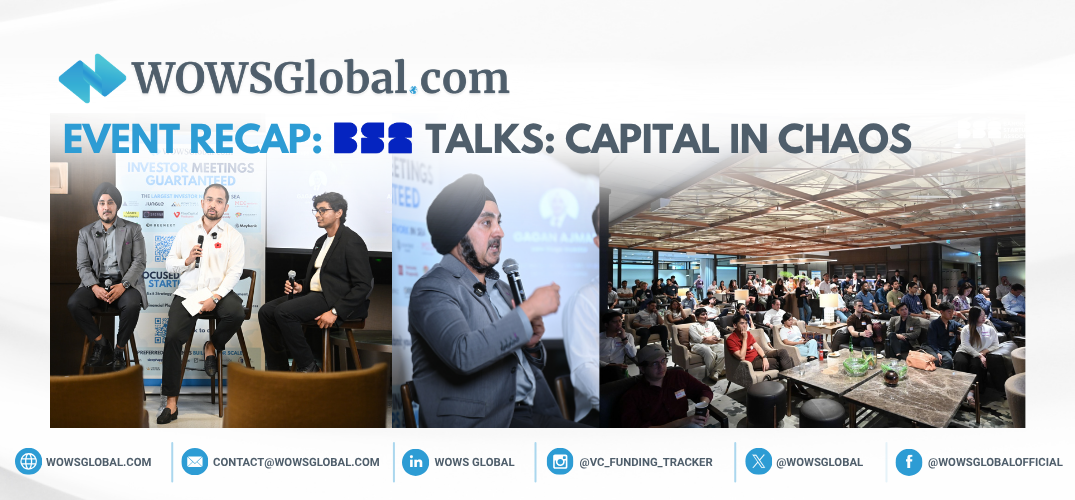
WOWS Global's Gagan Ajmani joined Bangkok Startup Association's Capital in Chaos event to unpack fundraising discipline, investor readiness and traction today.
At Capital in Chaos in Bangkok, WOWS Global CEO Gagan Ajmani discussed how founders can raise smarter in uncertain markets by focusing on traction, track record, investor readiness, and the right funding path for their business. -
SEA MENA Highlight Investment Funding 5 Minutes
Investment Highlights April 2026: SEA Builds The Rails And MENA Turns Credit Into Product
April’s startup funding story was not about fireworks. It was about rails. Across SEA and MENA, investors backed infrastructure, credit, climate, AI and regulated platforms with clearer paths to scale.