
September Investment Highlights: Fintech Consolidation, AI Infrastructure and Southeast Asia's Exit Window
Investment Southeast Asia Fintech AI 5 Minutes

September was the month Southeast Asia's capital story moved from private rounds toward public markets. A billion-dollar fintech acquisition, the Philippines' largest-ever IPO entering its final stretch, a data centre operator lining up a US listing, a new $7.8 B chip fab in Singapore and Vietnam's long-awaited market upgrade all point to the same conclusion: SEA venture capital is maturing, and investors are finally seeing real paths to liquidity. At the same time, early-stage founders face a tougher market than the headlines suggest.
Here's what moved Southeast Asia investments this month.
The Big Picture
The Kickstart Ventures and DealStreetAsia half-year report, released on 24 September, showed Southeast Asian startups raised $7.25 B across 217 deals in H1 2026, the strongest half since early 2022. But one transaction did most of the lifting: DayOne's $4.5 B data centre round. Strip it out and regional funding fell 21% half-on-half to roughly $2.75 B.
Beneath that, the numbers tell a story of concentration. Singapore captured close to 92% of equity funding. Deal volume hit its lowest level since at least 2018. The median seed round reached a record $3.7 M, while the median Series A slipped to $8 M from $11.6 M in late 2025. In short: bigger cheques, fewer of them, and a Series A bottleneck founders need to plan around.
Southeast Asia (SEA)
Top September 2026 deals in SEA:
- Grab x Atome Financial (Singapore) – On 15 September, Grab agreed to acquire a controlling 60% stake in BNPL and consumer lending platform Atome Financial for $1.49 B in cash, including $260 M of primary growth capital. It is Grab's largest acquisition to date, and Grab now targets a $6 B+ loan book by 2028. The super-app has decided lending is its next growth engine, and it is buying rather than building.
- iPiD (Singapore) – Raised $16 M in a Series A led by Foundation Capital, with Citi, HSBC, QED Investors, Monk's Hill Ventures and Quona Capital participating. The payment verification company will use the funds to expand into the US and Europe. Payment fraud prevention is quietly becoming core infrastructure.
- DANA (Indonesia) – Secured an investment (undisclosed) from 01Fintech, a growth equity firm dedicated to Asian fintech. A strong signal of late-stage appetite for Indonesia's leading e-wallets.
- DOKU (Indonesia) – Rebranded as "DOKU by Antom" as Ant International's merchant payments arm deepened its stake to become the largest shareholder, alongside a new CEO appointment. Regional payments consolidation continues, with global strategics taking the wheel.
Data Centres & AI Infrastructure
AI infrastructure remained the region's heaviest capital magnet, but September also showed its limits.
DayOne (Singapore) is reportedly pushing ahead with a US IPO as soon as November, potentially raising around $5 B, following its $4.5 B Series C. It would set a public benchmark for how global investors value Southeast Asian data centres.
Meanwhile, Thailand hit pause. On 4 September, the government asked developers to halt work on 49 data centre projects under construction and froze 117 pending approvals, 166 projects in all. Four subcommittees were given one month to draft national standards on power, water, siting and local benefit, so new rules could land in early October.
The month closed with fresh commitments elsewhere. On 29 September, Philippine infrastructure firm YCO Cloud and Singapore-based AI cloud provider Aolani announced plans to deploy more than 10,000 Nvidia Blackwell Ultra GPUs in the Philippines, with the first phase targeted for Q1 2027. It is one of the country's first large-scale sovereign AI clusters.
For investors, the message is clear: power, water and permitting, not demand, are now the binding constraints on AI infrastructure in the region. Operators with secured energy, operational capacity and regulatory clarity will command a premium.
Deep Tech & Semiconductors
The AI build-out is also pulling the chip supply chain deeper into Southeast Asia.
- VSMC (Singapore) – On 28 September, the Vanguard International Semiconductor (60%) and NXP (40%) joint venture opened its $7.8 B 300mm specialty-chip fab in Tampines. The plant will make power management, sensing and control chips for automotive and industrial markets, reach about 44,000 wafers a month by 2029 and create roughly 1,600 jobs.
- Samsung Electro-Mechanics (Vietnam) – Announced a $4.9 B investment in AI chip substrates, including $1.8 B to expand its Vietnam plant by April 2028. Vietnam is moving from assembly toward the high-value components inside AI servers.
- nanoSkunkWorkX (Malaysia) – Raised $2 M in seed funding led by Singapore's Tin Men Capital to commercialise its AI chip packaging materials. Small cheque, big theme: deep tech is moving down the semiconductor supply chain.
Fintech Capital Markets & Exits
- GCash (Philippines) – Parent company Mynt secured SEC approval on 3 September and Philippine Stock Exchange approval on 24 September for an IPO of up to ₱92.32 B, the largest in Philippine history. Cornerstone investors, including BlackRock, have committed around ₱36.5 B ahead of an October 20 listing. Warburg Pincus called it a potential watershed for PE-backed exits in the region.
- Vietnam – FTSE Russell's reclassification of Vietnam from frontier to secondary emerging market took effect on 21 September, opening the door to index-tracking foreign capital. That makes local IPOs a far more credible exit route for PE-backed companies.
- Private credit – Lendable closed its second MSME fintech credit fund at $255 M, above target, with Asian borrowers including Amartha and Validus. Asset-backed debt is filling gaps equity no longer covers.
Investor Insights
DealStreetAsia's Asia PE-VC Summit in Singapore (23–24 September) set the tone for Q4. Senior dealmakers from Bain Capital, Brookfield and Blackstone described a "K-shaped" market: strong buyer interest in data centres, semiconductors and strategic assets, and longer holding periods for consumer businesses. Bain Capital said it remains bullish on AI infrastructure.
On the venture side, Vertex Holdings, Kickstart Ventures, Peak XV Partners and Jungle Ventures flagged a structural gap in follow-on funding outside the mega-deals. Capital is available, but it is increasingly selective, later-stage and sector-specific.
WOWS Global Perspective
September's deals confirm what we see every day in our pipeline: Southeast Asia is entering a more disciplined, more rewarding phase. Capital is flowing toward companies with real revenue, defensible infrastructure and a credible path to exit, whether that is a strategic acquisition like Atome, a public listing like GCash, or structured debt alongside equity.
For founders, that raises the bar. A tight pitch deck, an investor-grade financial model, a defensible 409A valuation and a clean cap table are no longer nice-to-haves; they decide who gets through the Series A bottleneck. For investors and family offices, the opportunity lies in accessing vetted deal flow across fintech, deep tech and AI infrastructure before it reaches the headlines.
This is where WOWS Global works. With teams in Singapore, Dubai and Bangkok, we bring together investment banking, private lending and fractional CFO support to connect high-growth companies with the right capital across Southeast Asia and beyond. We help founders and investors act with confidence in a market that rewards preparation.
Expect Q4 to be defined by GCash's debut, DayOne's IPO window, and how quickly Thailand's new data centre rules take shape. We'll be tracking every move.
Raising capital or looking for curated Southeast Asia investment opportunities? Get in touch with WOWS Global.
Related Posts
-
Fractional CFO Business Founders Southeast Asia 6 Minutes
Fractional CFO Cost: Rates and Engagement Models in 2026
Understand fractional CFO costs in 2026, including monthly retainers, hourly rates, project fees and part-time engagement models. This guide explains what affects pricing, what to expect from a CFO engagement and how to choose the right financial support for your business. -
AI Investment Southeast Asia Capital 4 Minutes
Investment Highlights August 2026: Southeast Asia's Big-Check Era Takes Hold
The money is back in Southeast Asia, and it's arriving in bigger checks than ever. Capital jumped 137% to $12.8B this year while deal count fell 30%. Inside: Acrab's $130M AI raise, three blockbuster IPOs, and what the flight-to-quality market means for your next round. -
Investment Highlight Southeast Asia SEA 7 Minutes
Investment Highlights July 2026: Southeast Asia's Exit Window Swings Wide Open
July 2026 saw Southeast Asia's exit window swing wide open: GCash's record IPO run, MoMo's buyout interest, and fresh capital flowing into robotics, insurtech and AI. -
Investment Highlight SEA AI 6 Minutes
Investment Highlights June 2026: Southeast Asia Builds the AI Backbone While the Exit Window Cracks Open
Southeast Asia's June 2026 was deliberate, not euphoric. Capital concentrated around the AI infrastructure buildout, deep tech and health tech kept punching above their weight and, for the first time in three years, the exit window cracked open with GCash parent Mynt filing for a record US$1.5 billion IPO. We break down the deals that mattered, who's writing the cheques and what it all means for founders and investors. -
SEA Investment MENA Private Credit Fintech 7 Minutes
Investment Highlights May 2026: SEA Puts Data Centres on the Balance Sheet While MENA Turns Credit Into Infrastructure
May’s investment activity across SEA and MENA shows capital is still moving, but with sharper discipline. From data centres and green infrastructure in Southeast Asia to private credit and fintech rails in MENA, investors are backing companies with stronger fundamentals and clearer capital stacks. -
Emerging Markets SEA Bangkok Events Investment 3 Minutes
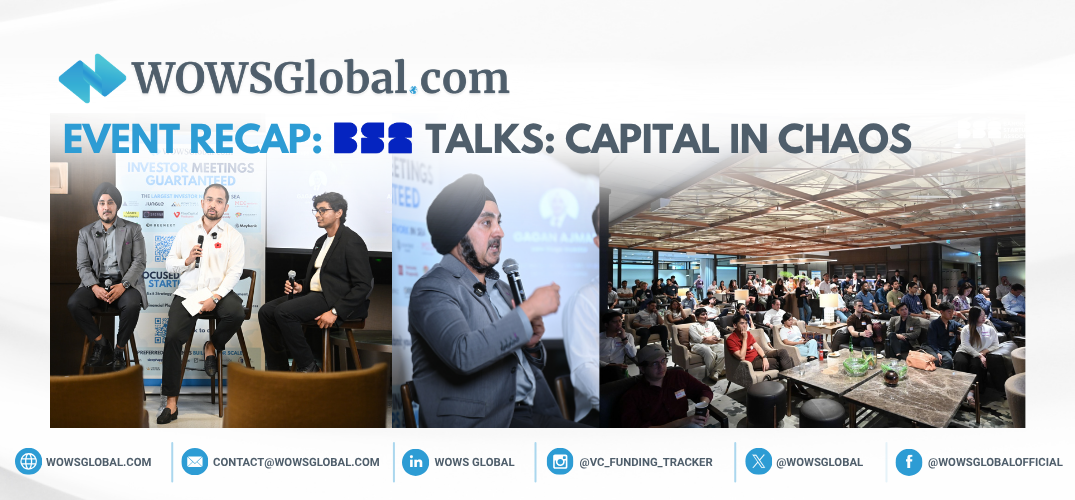
WOWS Global's Gagan Ajmani joined Bangkok Startup Association's Capital in Chaos event to unpack fundraising discipline, investor readiness and traction today.
At Capital in Chaos in Bangkok, WOWS Global CEO Gagan Ajmani discussed how founders can raise smarter in uncertain markets by focusing on traction, track record, investor readiness, and the right funding path for their business.